Over the past sixty years women have entered higher education and paid work in large numbers. The division of housework and care at home has changed much less. Many expected the two to converge. Instead, progress has stalled, and it has stalled unevenly. Some couples share paid and unpaid work. In others she works for pay and also does most of the housework. Others keep a male-breadwinner arrangement.
WeEqualize studies this from the point of view of the couple rather than the individual. It asks how couples in 24 industrialized countries have divided paid and unpaid work since the 1960s, how these arrangements differ by the partners’ education, and what shapes them: gender beliefs, work-family policies, labor market insecurity and changing patterns of partnership. The project combines large comparative surveys and household panels with new survey experiments, and it develops methods to measure couples’ arrangements in countries where data on both partners are not linked.
The project runs from September 2024 to August 2029 at the European University Institute in Florence and is funded by a Starting Grant of the European Research Council.
What the project does
- Map the arrangements. Build a typology of how couples combine paid work, housework and care that holds across countries and over time.
- Who does what, by education. Show how common each arrangement is among couples with different levels of education, in each country, and how this has changed.
- Context. Test how gender beliefs, work-family policies and economic insecurity shape which arrangements couples adopt.
- Demographic change. Assess how shifts in who partners with whom, and when, alter the picture, and project arrangements for the coming decades.
- Beliefs or constraints. Use survey experiments to separate what couples want from what their jobs allow.
What we have found so far
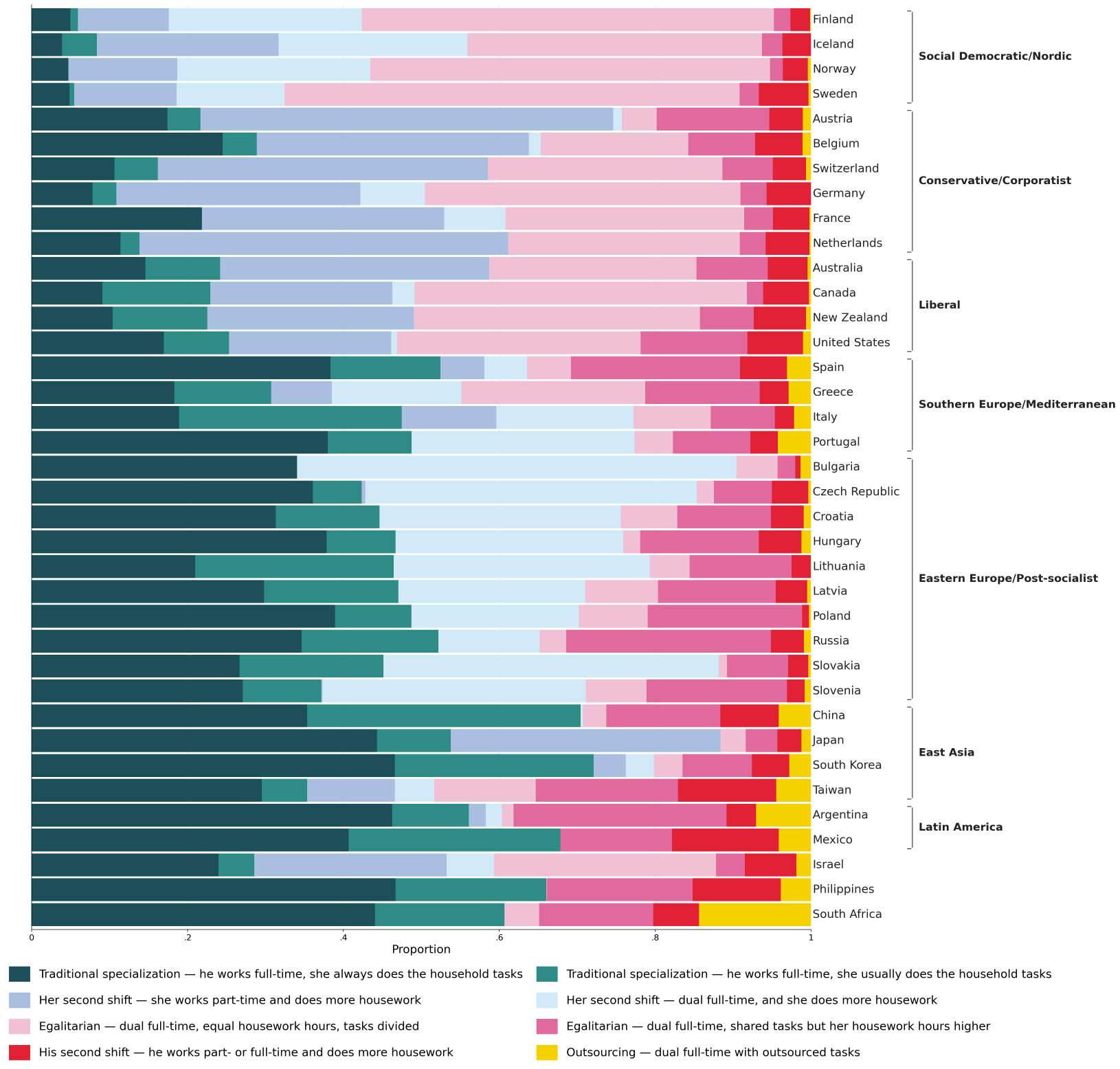
- One map fits many countries. Using the International Social Survey Programme (2012 and 2022), a single typology of eight work-family arrangements describes couples across 37 countries. Portier, McErlean and Pessin, Socius 2026.
- Education works differently for her and for him. Among US couples since 1968, couples in which she has more education than he are more likely to share paid and unpaid work, or to have her doing both. Where he has more education, the male-breadwinner arrangement persists. Couple-level education measures that ignore who holds the degree miss this. Pessin and Querin, Journal of Marriage and Family 2026.
- Same mess, different responsibility. In an experiment in which nearly 3,000 US respondents judged AI-generated images of homes, women were assigned more responsibility for cleaning than men for the same scene, most of all in dual-earner households. The gap comes from who is held responsible, not from seeing the room as messier. Pessin and Munger, Sociological Science 2026.
- Equality and marital stability depend on class. Among college-educated US couples, sharing paid work and specializing carry similar divorce risks. Among less-educated couples, moves toward equal paid work may reflect economic necessity rather than changing gender norms. McErlean, Socius 2025.
- Policy changes what equality costs. In US states with little support for working families, couples in which he is the main earner, or who specialize, are less likely to divorce. Where support is strong, divorce risk is the same across arrangements. McErlean, Social Forces 2026.
All publications | Team | News and talks
Key facts
- Project title: Social Inequalities in Work-Family Strategies Within and Across 24 Industrialized Countries
- Funder: European Research Council, Starting Grant 2023 (Horizon Europe)
- Grant agreement 101117327, DOI 10.3030/101117327
- Host institution: European University Institute, Department of Political and Social Sciences, Florence
- Duration: 1 September 2024 to 31 August 2029
- EU contribution: EUR 1,499,146
- Principal investigator: Léa Pessin
- Project description (ERC B1, PDF)
Contact
Léa Pessin, Principal Investigator
lea.pessin (at) eui.eu
Department of Political and Social Sciences, European University Institute, Via dei Roccettini 9, 50014 Fiesole, Italy
Funded by the European Union. Views and opinions expressed are however those of the author(s) only and do not necessarily reflect those of the European Union or the European Research Council Executive Agency. Neither the European Union nor the granting authority can be held responsible for them. This work is supported by ERC grant WeEqualize (101117327, DOI 10.3030/101117327).

